
How to Search Civil Dockets
Court assignment comes first in any Tunica County civil docket search. Circuit Court takes the larger civil actions plus anything reserved for it by law. Chancery Court covers domestic relations, estates, guardianships, conservatorships, equity, land, and closely related matters. Justice Court handles limited civil claims, including small ones within its authority. Keep this split in mind. A search that comes up empty in one court does not mean no civil case exists in another. For participating Circuit or Chancery cases, the remote route runs through the applicable MEC district. A registered PAMEC account is required. The case-search form itself stays behind the login. The Circuit Clerk's online order center provides a record request service. It is not a free published civil docket index. Justice Court offers no separate online civil-case search. Ask the Justice Clerk or inspect the records in person.
- Identify whether the paper or case type points to Circuit, Chancery, or Justice Court.
- Use the case number from the notice or prior clerk receipt when available. A statewide Tunica state-number format was not published.
- Register for PAMEC before attempting a participating Circuit or Chancery remote search, or contact the correct clerk for a limited-court file.
- Read the newest filing, setting, and signed order in the docket chronology.
- Request a plain copy, certified copy, or abstract from the clerk when an official record is needed.
Tunica Civil Docket Court Split
Every Tunica County civil docket has its own keeper. The Circuit Clerk holds Circuit Court civil filings. Rechelle R. Siggers, the Chancery Clerk, holds the Chancery Court records. Justice Court has a separate clerk and limited civil jurisdiction. The Town Municipal Court is not a general civil docket. Tunica's official 2026 directory lists no separate County Court. Don't assume a County Court database exists when you search.
| Court | Typical civil record | Clerk route |
|---|---|---|
| Circuit Court | Major civil, contract, property, tort, appeals, judgments | Circuit Clerk, Eleventh MEC/PAMEC |
| Chancery Court | Family, estate, guardianship, equity, and land matters | Chancery Clerk, Seventh Chancery MEC/PAMEC |
| Justice Court | Small civil, debt, damage, property, and limited-court matters | Justice Clerk at the Old Mhoon Landing Road office |
For a divorce, an estate, or a guardianship, a Circuit-only search may simply be the wrong door. With a small property claim, ask Justice Court first.
What a Civil Docket Shows
A Tunica County civil docket shows the case header plus a running timeline of papers and court action. The header may list the court or district. It may also show filing date, style, case type, judge or chancellor, and a status or disposition. The party block separates plaintiff or petitioner from defendant or respondent. PAMEC does not publish its exact field layout. So treat any list of items as an inventory of what may appear rather than a promise of what every result displays.
| Case identifier | Use the number on the summons, notice, or clerk receipt; no verified Tunica state format was published. |
|---|---|
| Parties and roles | Plaintiff or petitioner, defendant or respondent, intervenor, and attorney information where public. |
| Filing history | Complaint or petition, civil cover sheet, summons, return of service, answer, counterclaim, discovery notices, and motions. |
| Case management | Notices of setting, mediation, referrals, orders, trial activity, and a judgment or dismissal. |
| Later activity | Execution, garnishment, abstract, partial payment, renewal, cancellation, or appeal when the clerk maintains the entry. |
The caption alone never tells you who won. Read the service and answer entries before assuming a default, and read the newest signed order before treating a motion as granted.
Tunica Civil Docket PAMEC Access
PAMEC is the public, read-only layer of Mississippi Electronic Courts. It is not a free anonymous statewide civil-case search. A non-attorney public user registers and accepts the terms. The account carries a $10 annual fee. Users are charged $0.20 for each search-result page generated. A no-match search still counts as one billed page. The terms describe quarterly statements. Online payment generally opens access after processing, while a mailed check waits until it clears. Public registration asks for a user type and agreement. It also collects identity and contact fields, account credentials, security questions, CAPTCHA, and a payment method. Attorney, Non-Attorney, and Firm Administrator are the user choices. Those fields are documented publicly; the case-search filters and result screen are not. Bring exact court and case information, and ask the clerk if an authenticated query fails. The PAMEC registration screen shows the public account entry point and the user-type choices.
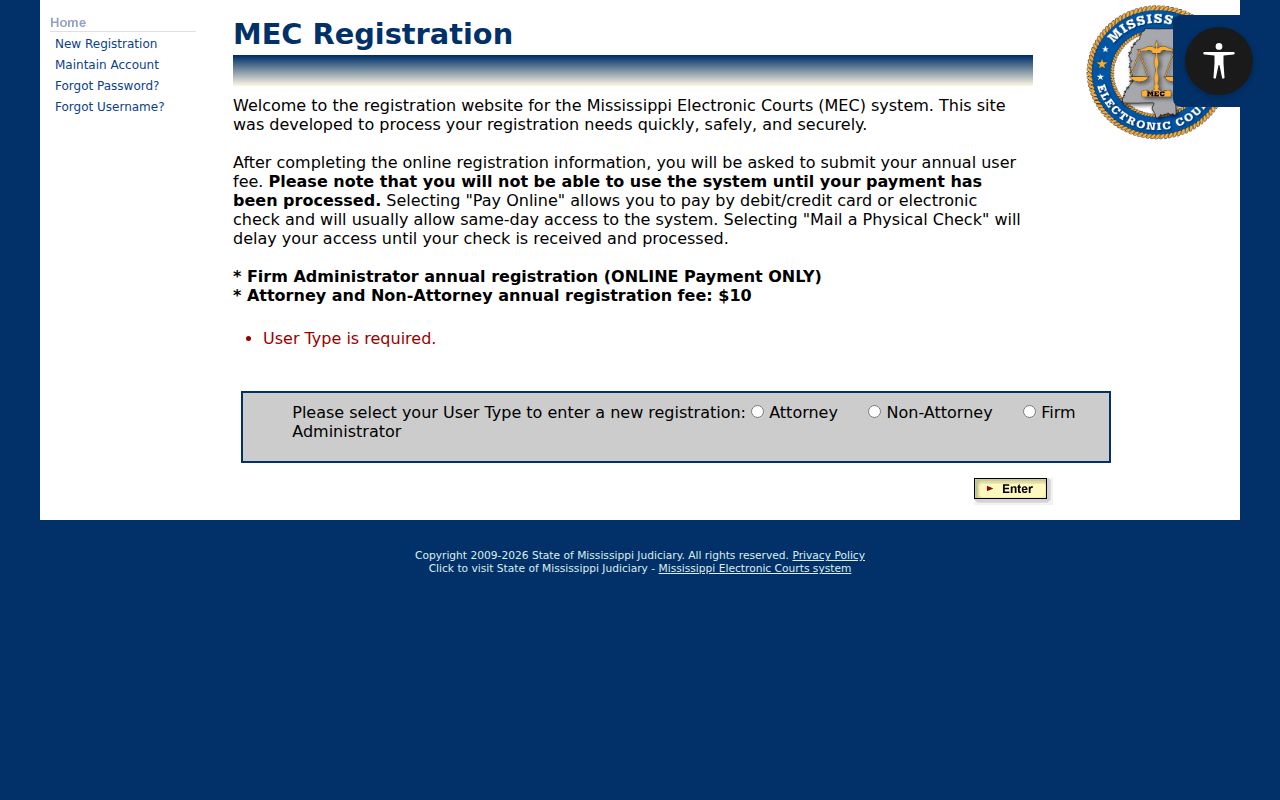
Registering only opens the door. It does not guarantee that a particular Tunica County civil docket is public or that every document can be downloaded.
Tunica Civil Docket MEC Milestone
The Seventh Chancery District MEC Court Information page reports the date. Tunica County Chancery Court went live in MEC on March 6, 2017. That date matters for researchers. An older Chancery file may need clerk assistance even when newer activity is electronic. It also confirms the Chancery system is separate from the Eleventh Circuit system. That Circuit system serves Circuit Court matters. The Seventh Chancery District MEC landing page is the official court-system entrance for that district.
The landing page identifies the electronic court system. For remote docket viewing, authenticated PAMEC access remains the public route.
Types of Civil Cases on the Docket
Civil docket categories vary by court in Tunica County. Circuit records can include major civil actions. Contract disputes, property claims, tort cases, appeals, and judgments also appear there. Chancery records hold domestic relations, estates, guardianships, conservatorships, equity, and land matters. Justice Court takes limited civil actions. These are commonly small debt, damage, and property questions within its statutory boundary. Municipal Court is not the normal route for a general civil file.
- Contract, property, tort, appeal, and judgment matters in Circuit Court.
- Divorce, custody, support, paternity, estate, guardianship, equity, and land matters in Chancery Court.
- Small civil, debt, damage, and limited property matters in Justice Court.
- Post-judgment activity such as abstract enrollment, garnishment, execution, renewal, or appeal.
Mississippi Justice Court guidance places many small civil matters at or below $3,500. Venue and current rules should be checked with the Justice Clerk. That step matters most for limited-court property matters.
Tunica Civil Docket Cover Sheet
Every Circuit civil case in Tunica County starts on paper. The Circuit Clerk's forms page requires a Civil Case Filing Form for each new case. That form is known as a cover sheet. File that with the complaint or petition and the case exists. From there the docket picks up the paperwork: issuance and return of summons or citation, an answer, a counterclaim, motions, notices of setting, and orders entered by the court.
Service deserves early attention. A caption alone tells you nothing about whether process was completed. Read any default entry alongside the service and answer history before drawing conclusions. The same caution applies to motions. A motion line is only a request. The signed order tells you whether the court granted it, denied it, continued it, or handled it some other way.
Settings and Hearings on Civil Dockets
A civil setting records the date, time, court location, judge or chancellor, and type of proceeding when the court releases that information. Tunica County publishes no official daily or weekly civil calendar. There is no searchable hearing list and no permanent remote calendar either. The statewide judicial directory helps with court terms. But it is not a live case calendar. For a particular hearing, trust the docket's newest setting and the current written notice.
A continuance or reset changes the current date only. The earlier setting stays in the docket history. Compare the latest order or notice with the newest docket entry. Then call the right clerk if the time or place is still unclear: the Circuit Clerk at 662-363-2842, the Chancery Clerk at 662-363-2451, or the Justice Clerk at 662-363-2178. No official source promises that a clerk can reset a matter over the phone.
Tunica Civil Docket MEC Flags
MEC flag text marks where a civil file stands procedurally. "MOTREF" means a motion has been referred. "MEDIATION" and "ARBITRATION" flag alternative dispute resolution. "ENE" signals early neutral evaluation, and "SM" can mark a special-master entry. Treat every flag as a short process marker. It is no substitute for the signed order or the current notice.
- MOTREF
- A motion has been referred. Read the referral and later order to learn what happened next.
- MEDIATION
- The docket reflects a mediation process or related setting, not necessarily a final settlement.
- ARBITRATION
- The docket reflects arbitration activity or a related process flag.
- SEALED
- Access is restricted by rule or order. It is not an outcome on the merits.
- Partial_Pmt
- A partial-payment status may appear where the clerk maintains financial information.
The Seventh Chancery Court Information page is the official source for the district system and its vocabulary.
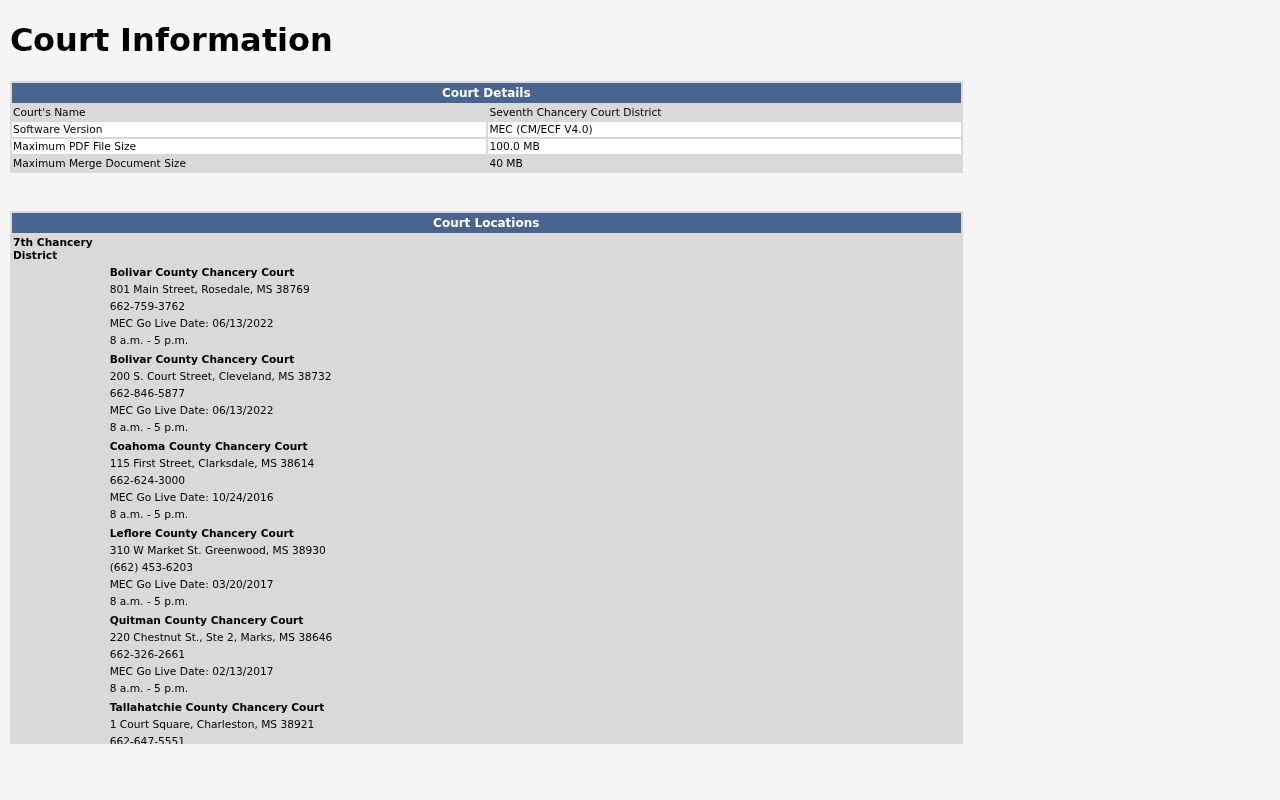
The public information page separates system labels from actual outcomes. Authenticated case results require a paid account, so a flag alone proves nothing about how a matter ended.
Tunica Civil Docket Judgment Trail
A civil docket does not necessarily go quiet after judgment. Later entries can cover abstract enrollment, garnishment, cancellation, renewal, execution, partial payment, or an appeal. The Tunica County Circuit Clerk fee schedule lists $35 for garnishments. It also lists $5 for foreign or abstract judgment enrollment, $1 for cancellation, and $35 for renewal. Those lines reflect post-judgment activity. They do not automatically mean a new lawsuit was filed.
For everyday reference, a plain copy is often enough. Another court or an official filing may demand a certified copy instead, and an abstract serves a different judgment-enrollment or enforcement purpose. The Circuit Clerk's listed prices run $1 for copies. Certification costs $3.50, and abstracts cost $5. Confirm what the recipient needs and the clerk's current total before you order.
Public Access to Civil Dockets
Getting into a Tunica County civil docket starts with the right clerk. PAMEC offers registered remote access to participating Circuit and Chancery docket sheets and non-restricted documents. Its own terms and fees apply. Free electronic viewing at the clerk's office during regular hours is the documented alternative. The Circuit Clerk's order center sells a separate paid record-search or copy service. Chancery and Justice copy terms should be confirmed with those offices directly.
Some civil subject areas stay restricted in PAMEC even when the docket text remains visible. The published terms list categories such as debt collection, garnishment, replevin, child custody and visitation, child support, divorce, paternity, termination of parental rights, birth-certificate correction, conservatorship, guardianship, minor settlements, and protection-from-domestic-abuse matters. A court order can restrict access further. No written records request overrides a court restriction.
Key Rules:
MEC public-access terms describe registered read-only access, billing, free clerk-office viewing, and restricted electronic documents.
Mississippi Public Records Act supplies general public-record principles, subject to court rules and exemptions.
Miss. Code §9-1-53 authorizes electronic filing and storage under the court system’s governing rules.
Mississippi Chancery Youth Court reform is relevant to youth-record access and should be checked against current enacted law.
Tunica Civil Docket PDF Limits
A PAMEC docket sheet and its underlying PDFs carry different access boundaries. A nonparty may see the docket chronology. But electronic documents in a restricted family, guardianship, support, or sealed matter stay unavailable. A missing PDF does not mean the case is gone. It can reflect the correct court, a restriction, an order, party-only access, or simply an older paper record.
First confirm whether the case belongs in Circuit, Chancery, or Justice Court. Then ask the proper clerk whether public in-person inspection, party access, or a court order is required. MEC procedures also redact or omit personal identifiers. When access is in doubt, the clerk and the court rule. A general remote search result does not control the decision.
Tunica Civil Docket Copy Choices
The Circuit Clerk handles all Circuit civil copies and certifications. The official Circuit Clerk fee page lists the charges. Expect a $10 record search, $1 copies, $3.50 certification, and $5 abstracts. Chancery Court records belong to the Chancery Clerk at 1300 School Street or P.O. Box 217, phone 662-363-2451. Justice Court civil records sit with the Justice Clerk instead. That office is at 5130 Old Mhoon Landing Road, phone 662-363-2178.
A mailed request should spell out the basics. Name the court, the case number, and the party names. Add the item you want, the date range, the copy type, and a return address. The clerk publishes no processing-time promise. Ask for a fee estimate and current instructions before sending any payment.